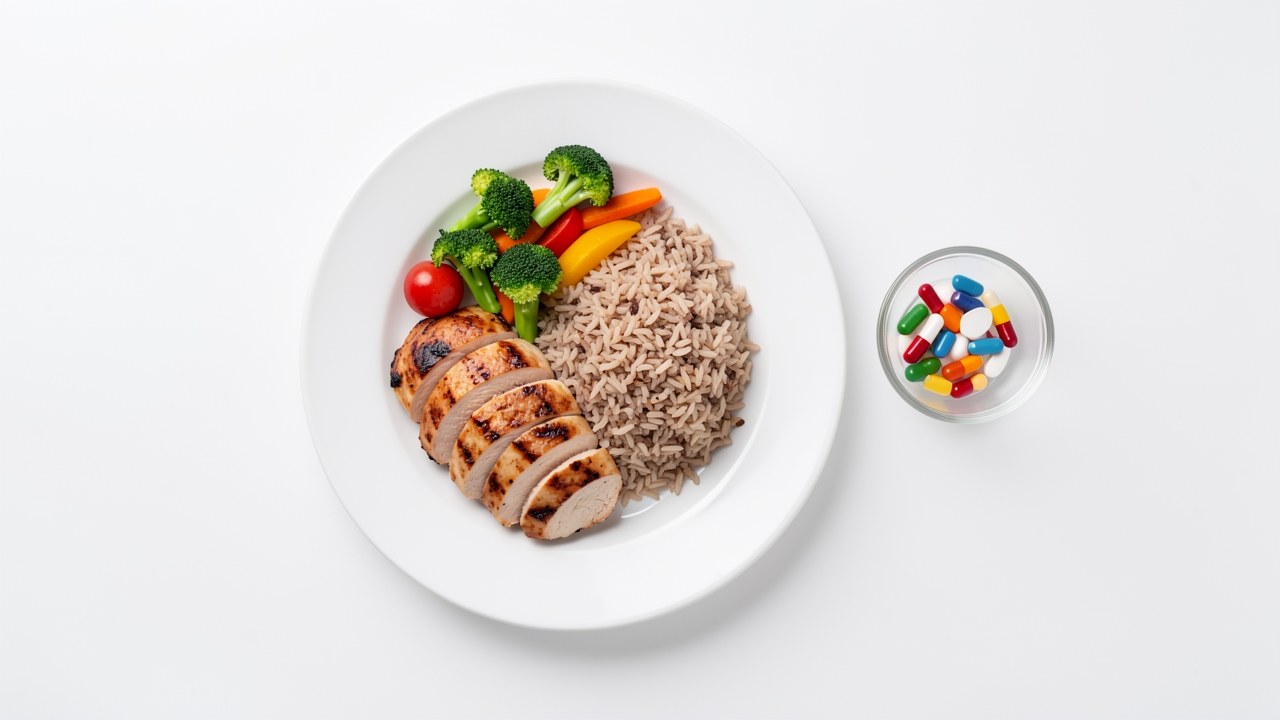
What are Dietary Reference Intakes (DRIs)?
Dietary Reference Intakes (DRIs) are a set of nutrient-based reference values developed by the Food and Nutrition Board of the U.S. National Academies (now the National Academy of Medicine) starting in the 1990s. They replaced earlier guidelines in the United States and Canada, including the Recommended Dietary Allowances (RDAs) in the U.S. and Recommended Nutrient Intakes (RNIs) in Canada.
DRIs are intended for use in planning and assessing diets of healthy individuals and groups. They are not designed for people with chronic or acute diseases, who may have different nutrient needs.
The DRI system covers a range of nutrients, including vitamins and minerals, and provides values for different life stages and gender groups.
Sources: Encyclopedia.com, EBSCOhost, Wikipedia
Key Terms: RDA, AI, UL, and EAR
The DRI system includes four main types of reference values: Estimated Average Requirement (EAR), Recommended Dietary Allowance (RDA), Adequate Intake (AI), and Tolerable Upper Intake Level (UL). Each serves a distinct purpose in evaluating nutrient intake.
The EAR is the average daily nutrient intake estimated to meet the requirements of 50% of healthy individuals in a given life stage and gender group. It is used as the basis for the RDA.
The RDA is the average daily dietary intake level sufficient to meet the nutrient requirement of nearly all (97–98%) healthy individuals in a particular life stage and gender group. It is calculated from the EAR, typically by adding two standard deviations of the requirement, assuming a normal distribution of needs.
When scientific data are insufficient to determine an EAR and thus an RDA, an AI is set based on observed or experimentally determined estimates of nutrient intake for healthy people. The AI is a recommended average daily intake level, but it is a less precise estimate than the RDA.
The UL is the highest level of daily nutrient intake that is likely to pose no risk of adverse health effects for nearly all individuals in the general population. Consistently exceeding the UL increases the risk of adverse effects.
Sources: Medicine LibreTexts, ScienceDirect, EBSCOhost, SlideShare
How DRIs Are Established
The Food and Nutrition Board of the U.S. National Academies (now the National Academy of Medicine) establishes DRIs through an extensive review of scientific evidence. Expert panels examine data on nutrient requirements and health outcomes to set values for each life stage and gender group.
For many nutrients, the EAR and RDA are derived from clinical and laboratory studies. When data are insufficient to establish an EAR, the committee may set an AI based on the observed intakes of healthy populations.
DRIs are periodically reviewed and updated as new evidence emerges. For example, calcium and vitamin D previously only had AIs, but updated guidelines in 2011 established EAR and RDA values for both adults and children over one year of age. The DRI for energy was updated in 2023.
Sources: Encyclopedia.com, Medicine LibreTexts, EBSCOhost, SlideShare
DRI Values for Vitamins
The table below summarizes the DRI categories for selected vitamins. Because exact numerical values can vary by age, sex, and life stage, this table gives an overview of how each vitamin is classified. For detailed numbers for your specific age and gender, consult the official National Academies reports.
| Nutrient | Type of DRI typically set |
|---|---|
| Vitamin A | RDA |
| Thiamin (B1) | RDA |
| Riboflavin (B2) | RDA |
| Niacin (B3) | RDA |
| Vitamin B6 | RDA |
| Folate | RDA |
| Vitamin B12 | RDA |
| Vitamin C | RDA |
| Vitamin E | RDA |
| Vitamin D | RDA (since 2011) |
| Vitamin K | AI |
| Pantothenic acid | AI |
| Biotin | AI |
| Choline | AI |
Sources: EBSCOhost
DRI Values for Minerals
As with vitamins, the DRI framework provides EAR, RDA, and AI values for minerals based on available data. Examples of minerals with established EARs and RDAs include phosphorus, magnesium, selenium, and zinc for adults and children over one year. Calcium now has an RDA since the 2011 update.
For minerals where data are limited, such as fluoride, only an AI has been set.
Again, detailed numerical values depend on age and gender, so refer to official sources for precise recommendations.
| Mineral | Type of DRI typically set |
|---|---|
| Calcium | RDA (since 2011) |
| Phosphorus | RDA |
| Magnesium | RDA |
| Selenium | RDA |
| Zinc | RDA |
| Fluoride | AI |
Sources: EBSCOhost
How to Use DRIs in Daily Life
DRIs are useful for planning your diet and evaluating whether your nutrient intake is likely adequate. Here are some practical tips:
To plan a balanced diet, aim to meet the RDA or AI for most nutrients. The RDA is enough for nearly all healthy people, so you do not need to exceed it. The AI serves as a target when no RDA is available, but it is based on less definitive data.
To assess your intake, compare the nutrients in foods you eat over several days against the DRI values for your age and sex. Many nutrition tracking tools use DRI values as a reference.
Keep in mind that the UL is not a target; it is the upper limit beyond which risk of adverse effects increases. Regularly consuming amounts above the UL, by itself, can be harmful, especially with supplements.
- Use DRI values as a guide for healthy individuals, not as a prescription for disease treatment.
- Remember that DRIs apply to healthy people; if you have a chronic condition, your needs may differ.
- Consider your entire diet, not single nutrients in isolation.
Sources: Encyclopedia.com, EBSCOhost, SlideShare
Frequently asked questions
What is the difference between RDA and AI?
The Recommended Dietary Allowance (RDA) is the average daily intake sufficient to meet the nutrient requirement of nearly all (97–98%) healthy individuals in a specific life stage and gender group. It is derived from the Estimated Average Requirement (EAR). In contrast, the Adequate Intake (AI) is used when data are insufficient to determine an EAR or RDA. The AI is an estimate based on observed or experimentally determined intakes of healthy people, but it is less precise than the RDA.
Sources: Encyclopedia.com, EBSCOhostHow do DRIs differ for adults and children?
DRIs are set for specific life stages and gender groups. For children over one year old, many nutrients have established EARs and RDAs. However, for infants under one year of age, data are usually insufficient to calculate more than an AI. Values generally increase with age as body size and needs grow, and they differ for males and females, particularly after adolescence.
Sources: EBSCOhostWhat happens if you consistently exceed the UL?
The Tolerable Upper Intake Level (UL) is the highest daily nutrient intake likely to pose no risk of adverse health effects for nearly all individuals. Exceeding the UL consistently increases the risk of toxicity and other adverse effects. It is important not to routinely consume amounts above the UL from food and supplements combined.
Sources: Medicine LibreTexts, ScienceDirect, EBSCOhostHow can I find my daily value for a specific nutrient?
Detailed DRI values are published by the National Academies of Sciences, Engineering, and Medicine. You can find tables that list EAR, RDA, AI, and UL for each nutrient, broken down by age and sex. Alternatively, use reputable nutrition websites or apps that incorporate these reference values.
Sources: EBSCOhostAre DRIs the same as Daily Values on food labels?
No, DRIs and Daily Values (DVs) are not the same, but they are related. DVs are used on food and supplement labels in the U.S. to show how a serving of food contributes to a daily diet. They were updated in 2016 to better reflect current DRI values, but DVs are based on a single set of reference values (e.g., for adults) and are not specific to age or gender.
Sources: EBSCOhost, WikipediaDo DRIs apply to supplements?
DRIs are intended for healthy individuals and are used to plan and assess diets that include both food and supplements. The RDA or AI can be used as a target for total intake from both sources. However, the UL is particularly important when taking supplements, because high doses of individual nutrients can quickly push you above safe levels.
Sources: Encyclopedia.com, EBSCOhostSources
- Dietary Reference Intakes | Encyclopedia.com — Encyclopedia.com
- 2.4: Understanding Dietary Reference Intakes (DRIs) - Medicine LibreTexts — Medicine LibreTexts
- Dietary Reference Intake - an overview | ScienceDirect Topics — ScienceDirect
- Dietary reference intakes (DRI) | Nutrition and Dietetics | Research Starters | EBSCOhost — EBSCOhost
- Dietary Reference Intakes | PPTX — SlideShare
- Dietary Reference Intake - Wikipedia — Wikipedia